
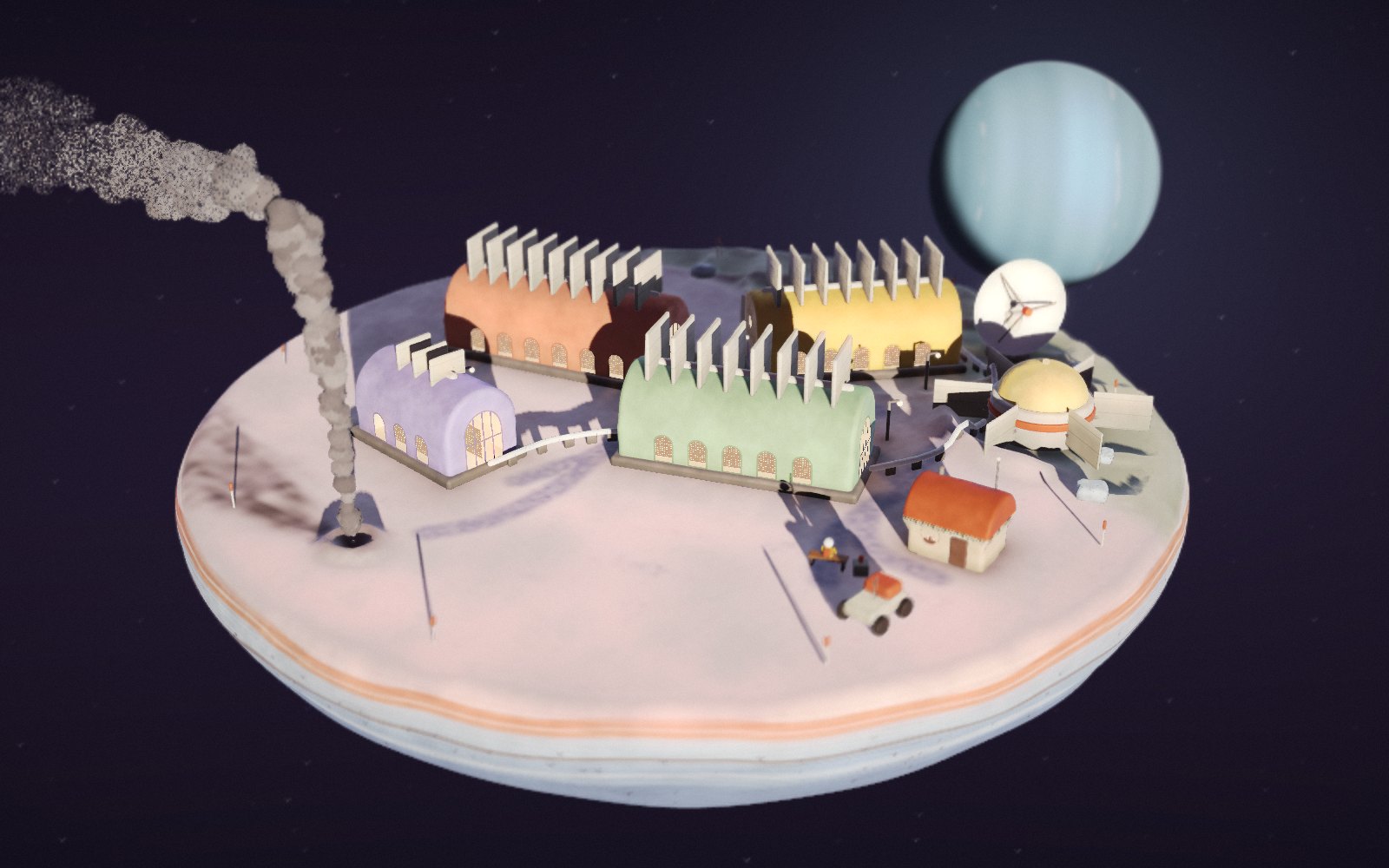
Computing on Triton, Neptune’s largest moon
A small computing campus on Neptune’s moon. It runs the work that can wait: long training runs, slow simulations, a copy of our libraries.
A message sent from Earth now arrives …. The answer reaches home ….
Imagined, not planned. The sky and the clocks are real.
Built in your browser. Needs WebGL2.
Drag to turn · scroll or pinch to zoom · click a hall
Notes
A place I imagined: a small computing campus on Triton, Neptune’s largest moon. Nobody is planning it. The halls, the jobs and the caretaker are made up. The sky, the light delay and the clocks are real, worked out from the time on your device.
Some work doesn’t need a quick answer. A training run takes weeks. A climate ensemble takes a month. If the answer can wait, the computer can be far away, and four light-hours is far.
The cold is interesting too. The least energy needed to erase one bit is kT ln 2 (Landauer’s limit), and it falls with temperature. Triton’s surface is about 38 K, so the limit there is about eight times lower than at room temperature: 3.6 × 10⁻²² J instead of 2.9 × 10⁻²¹ J. Today’s chips use thousands of times more than the limit, so this is a far horizon, not today’s reason.
Some things work better in the cold now. Many superconductors work at Triton’s temperature (YBCO below 93 K, MgB₂ only just, below 39 K), so power cables could lose almost nothing.
The cold doesn’t make cooling easy. There is almost no air, about 14 microbars when Voyager 2 passed, so heat can only leave as infrared light. A radiator gives off about 460 W per square metre at 300 K, and about 0.12 W at 38 K. So the halls run warm and wear big fins.
You can’t run the chips at 38 K and shed the heat at 38 K either: the radiators would need to be thousands of times bigger. Pumping the heat up to a warmer radiator costs energy, which gives back most of the Landauer saving. Thermodynamics is strict about this.
Sunlight is about 1/900 of Earth’s, so the power has to be nuclear. And light takes four hours each way. Nothing interactive can live here: no chat, no search. Only jobs that can wait. Voyager 2 took twelve years to get to Neptune.
Triton keeps one face to Neptune, so from the campus Neptune stays in one place, about 8° above the horizon and 8° wide, roughly fifteen times the width of the full Moon. Over 5.9 days it fills and thins as the Sun goes round.
Triton orbits backwards, against Neptune’s spin, so here the Sun rises in the west. These years the Sun stays far south, so Neptune never goes fully dark or fully lit (this year, between about 6% and 94%).
Sunlight here is 1/900 of Earth’s. That is still hundreds of times brighter than a full Moon, but only about as bright as a dim room, so days look like a bright dusk with sharp shadows, and lit windows glow even at noon. Neptune-light at night is about as bright as a full Moon on Earth.
Neptune is drawn in its true pale blue, following Patrick Irwin and colleagues’ 2024 rebalancing of Voyager and Hubble images; older pictures were contrast-stretched to a deeper blue. The model sits in front of the sky like a painted backdrop so you can see Neptune behind it. From the ground it would be just above the horizon, in the same direction.
Pink-white nitrogen frost of the south polar cap, and the dimpled “cantaloupe terrain” Voyager 2 photographed. The geyser and its dark streaks are like the ones Voyager saw, drawn much smaller. The cut side is a guess at what’s underneath: a thin pinkish layer, then water ice as hard as rock.
Light delay: Earth and Neptune from JPL’s approximate planetary orbits, checked against JPL Horizons (within a second for 2026–27). The Sun and Neptune in Triton’s sky: Triton’s 5.876-day cycle and the Sun’s latitude, fitted to Horizons for 2020–2040. The jobs are invented but run on the real clock, so everyone visiting at the same moment sees the same thing.
The halls are named for Le Verrier and Adams, who calculated where Neptune had to be; Galle, who found it on 23 September 1846; and Lassell, a brewer with a home-made telescope, who found Triton seventeen days later.
Drag to turn, scroll or pinch to zoom, click a building. Keys: arrows or WASD turn, + and − zoom, 1–4 halls, T time-lapse, E as Earth sees it, P photo, H hide the interface, R reset, Esc close.
An experiment by San Kala, built with Claude. No tracking, no account; everything is made in your browser. More places ↗ · Paper Robots films · Source